Which precedes the other?
Are they independent constructs?
Does one generate the other?
Can either exist in isolation?
These are not merely philosophical curiosities for me. They sit at the heart of the work I am developing around encouragement. If encouragement is the disciplined practice of cultivating courage in ourselves and in the next generation, then understanding how courage is formed becomes essential.
One conceptual model I have been testing looks like this.
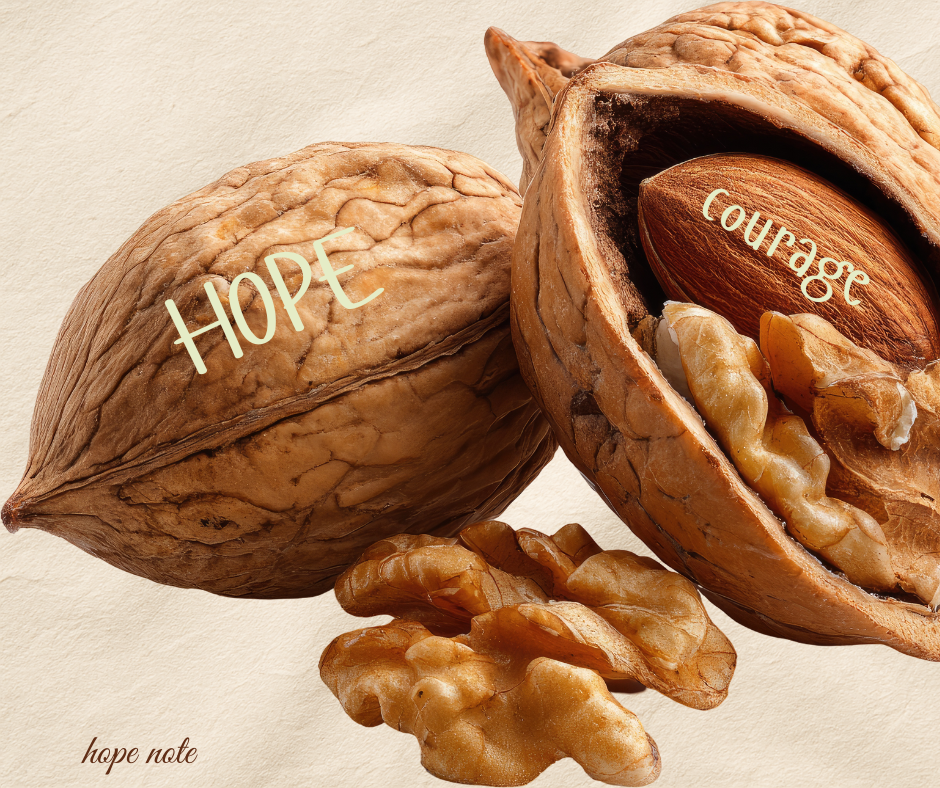
I imagine hope as a tree nut. A firm outer shell that must be cracked open. At its center is courage. The substantive core. The part that provides nourishment and fuel. In this framing, hope functions as structure and containment. It protects and encases something potent.
Within this model, hope is not sentimental. It is not passive. It is not naïve optimism. It is a stabilizing force that holds the conditions necessary for courage to emerge.
But the metaphor can be inverted, too.
Perhaps courage is the protective shell. Perhaps courageous action creates the external strength within which hope can take root and grow. In this view, hope may be the more interior, sustaining force.
A third possibility is that hope and courage are not hierarchically related at all. They may operate as parallel capacities that converge at the moment of decision. When an individual chooses to step forward in uncertainty, both hope and courage may be activated simultaneously.
From a developmental perspective, this distinction matters. If hope precedes courage, then cultivating grounded hope becomes preparatory work. If courage precedes hope, then action itself may generate the conditions for hope to grow. If they are reciprocal, then strengthening either one may reinforce the other.
In the Piecework framework I use to articulate a theory of encouragement, we begin with inner alignment. We attend to the pieces and parts within ourselves, not to escape reality, but to increase coherence. My working hypothesis is that when hope becomes grounded in reality rather than fantasy, it shifts from abstraction to substance. And when hope becomes substantive, courage becomes more accessible.
What I consistently observe is this: when individuals recognize that hope is not a soft idea but a disciplined orientation toward action, courage tends to follow.
This inquiry is not theoretical for me. It directly informs the work of ChangemakerYOU. If our mission is to encourage the authentic voices of the next generation of changemakers, then we must understand how courage is cultivated and sustained. Whether courage grows inside hope, alongside it, or in reciprocal relationship with it, the intentional tending of both becomes essential. The clearer we are about their interplay, the more effectively we can prepare ourselves and others to act with integrity and purpose.
Still, I am curious how others see this relationship.
In your view, which statement best reflects the relationship between hope and courage?
- Courage lives inside hope.
- Hope lives inside courage.
- They develop together and are mutually reinforcing.
- They are distinct capacities that operate independently.
I welcome your thoughts in the comments below.
keeping my hopes up,
p